In short: an employer must grant a pregnant employee 90 days of maternity leave before and after childbirth — 100 days for a premature birth, 120 days for a multiple birth — with at least 45 days (60 for a multiple birth) reserved for after the birth (Labor Standards Act, Article 74(1)), and the first 60 days (75 for a multiple birth) must be paid, although the employer’s obligation is reduced by any maternity leave benefits paid for that period (Labor Standards Act, Article 74(4)); at an employer that is not a priority-support enterprise, Employment Insurance covers only days beyond the first 60 (or 75), up to 30, 40, or 45 days (Employment Insurance Act, Article 76(1)1). Separately, an employee whose spouse gives birth is entitled to 20 days of paid spouse leave, usable in up to 3 segments before 120 days have passed since the birth (Act on Equal Employment Opportunity and Work-Family Balance Assistance, Article 18-2(1), (3), (4)) — and since September 18, 2026, that leave, now called prenatal and postnatal spouse leave, can also begin up to 50 days before the spouse’s expected due date (Article 18-2(3)).
How many days of maternity leave, and how they must be split (Labor Standards Act, Article 74(1), (2))
An employer must grant a pregnant employee a total of 90 days of maternity leave before and after childbirth. That figure rises to 100 days if the employee gives birth prematurely, and to 120 days if she is pregnant with two or more children at once. Whichever figure applies, the leave period must be arranged so that at least 45 days fall after the birth — or at least 60 days after the birth, for a multiple birth (Labor Standards Act, Article 74(1)). The Ministry of Employment and Labor’s own rule defines the scope of what counts as a premature birth, and the procedure for granting the leave, in more detail than the Act itself sets out.
There is also a specific accommodation for an employee who has previously had a miscarriage or who has another reason set out in the Enforcement Decree: for her, the employer must allow the leave to be split and used at any point before the birth, on request, though the post-birth portion must still be taken consecutively and must still meet the 45-day (or 60-day) minimum (Labor Standards Act, Article 74(2)).
Separately from maternity leave itself, an employer must grant miscarriage or stillbirth leave, on request, to an employee who has a miscarriage or stillbirth, following rules set by Presidential Decree — except for a miscarriage caused by an artificial termination of pregnancy other than one performed under Article 14(1) of the Mother and Child Health Act (Labor Standards Act, Article 74(3)).
What’s paid, and by whom (Labor Standards Act, Article 74(4); Employment Insurance Act, Articles 75–77)
Of the total leave period, the first 60 days are paid — 75 days for a multiple birth — and the employer bears that cost directly (Labor Standards Act, Article 74(4)). Where maternity leave benefits have separately been paid for that period, the employer’s payment obligation is reduced by the amount already covered, so the two payments are not stacked on top of each other.
Employment Insurance separately pays maternity leave benefits to an eligible insured employee, calculated at the employee’s ordinary wage as of the start of the leave (Employment Insurance Act, Article 76(1)). To qualify, the employee’s insured unit periods, meaning the days for which wages were paid while insured (Employment Insurance Act, Article 41), must total at least 180 days as of the end of the leave, and the employee must apply within a set window (for maternity or miscarriage/stillbirth leave at an employer that is not a priority-support enterprise, the leave is treated as beginning 60 days — 75 for a multiple birth — after it actually starts): generally between one month after the leave begins and 12 months after it ends, though someone who could not apply in that window for a reason set by Presidential Decree instead has 30 days from when that reason ends (Employment Insurance Act, Article 75).
How much of the leave period Employment Insurance actually pays for depends on the employer’s size. For an employer that is not a priority-support enterprise, the benefit only covers the days of leave that exceed 60 (or 75, for a multiple birth) — and even then, only up to a cap: 30 additional days in the standard case, 40 days for a premature birth, and 45 days for a multiple birth (Employment Insurance Act, Article 76(1)1). For a priority-support enterprise, that proviso does not apply, so Article 76(1)1 covers the whole maternity leave period, subject to the benefit caps described below.
The Enforcement Decree leaves the maximum benefit amount to be set each year by Ministry of Employment and Labor notice, based on factors including the average ordinary wage of recipients, inflation, and the minimum wage (Enforcement Decree of the Employment Insurance Act, Article 101, item 1). For leave taken in 2026, that notice sets the maximum at ₩6,600,000 for the standard 90-day leave (prorated for a leave period shorter than 90 days), ₩7,333,330 for a 100-day premature-birth leave, and ₩8,800,000 for a 120-day multiple-birth leave (Ministry of Employment and Labor Notice No. 2026-67, in effect from September 18, 2026 and valid through December 31, 2026; it replaced Notice No. 2025-124, which set the same amounts). The minimum benefit amount is not set by a separate notice: it is tied to the hourly minimum wage in effect at the start of the leave, applied whenever an employee’s hourly ordinary wage would otherwise fall below that figure (Enforcement Decree of the Employment Insurance Act, Article 101, item 2).
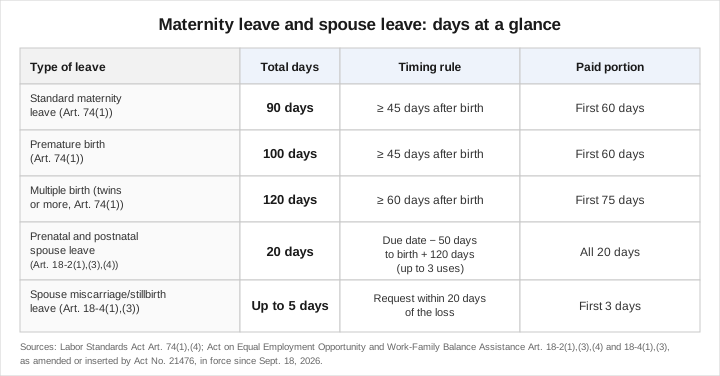 Sources: Labor Standards Act, Article 74(1), (4); Act on Equal Employment Opportunity and Work-Family Balance Assistance, Articles 18-2(1), (3), (4) and 18-4(1), (3).
How to claim the Employment Insurance benefit. The claim form goes to the public employment center with jurisdiction over either your home or your workplace. The government’s Work24 portal (work24.go.kr) takes maternity leave claims online: the employer first files the leave confirmation through its business account, and then you file the claim through your personal account. The attachments are the leave confirmation issued by your employer (for maternity or miscarriage/stillbirth leave, only with the first claim), records showing your ordinary wage such as a payroll ledger or employment contract, and records of any money the employer paid you during the leave. Depending on the type of leave, you also attach a medical certificate showing a premature birth, a miscarriage or stillbirth, the expected due date (where prenatal and postnatal spouse leave was used before the birth), infertility treatment, or the spouse’s miscarriage or stillbirth (Enforcement Rule of the Employment Insurance Act, Article 121(1)). Maternity and miscarriage/stillbirth leave pay is claimed in 30-day blocks; a period of use shorter than 30 days can be claimed as it is, and after the leave ends the whole leave can be claimed at once. Prenatal and postnatal spouse leave, infertility treatment leave, and spouse miscarriage/stillbirth leave pay is claimed all at once after the leave ends (Article 121(3)). Your employer must issue the confirmation when you ask for it, and if the employer refuses without a valid reason, the employment center can demand it from the employer directly (Article 123). General questions go to the Ministry of Employment and Labor’s call center at 1350.
Prenatal and postnatal spouse leave (Act on Equal Employment Opportunity and Work-Family Balance Assistance, Article 18-2)
Where an employee notifies the employer of leave because of the spouse’s pregnancy and childbirth, the employer must grant 20 days of leave, and that leave is paid (Act on Equal Employment Opportunity and Work-Family Balance Assistance, Article 18-2(1)). The Act has called this “prenatal and postnatal spouse leave” since September 18, 2026; before that date it was “spouse childbirth leave,” granted because of the spouse’s childbirth only (Act No. 21476). Where Employment Insurance benefits for the leave (the Act’s “maternity leave benefits, etc.,” a term that includes the spouse leave benefit) have been paid, the employer’s payment obligation is reduced up to that amount, mirroring the offset rule for maternity leave itself (Article 18-2(2)).
The leave can be used starting 50 days before the spouse’s expected due date, cannot be used once 120 days have passed from the date the spouse gave birth, and may be split across no more than 3 separate uses (Article 18-2(3), (4)). To give notice, the employee submits a document (an electronic document counts) stating the dates the employee intends to use, the spouse’s date of birth or expected due date, and the date of the notice; the employer may ask for documents proving the pregnancy or birth (Article 18-2(6); Enforcement Decree of the Act, Article 9-2). An employer may not dismiss an employee, or give the employee any other unfavorable treatment, on the grounds of taking spouse leave (Article 18-2(5)). Employment Insurance covers the cost of spouse leave through a benefit, but — unlike maternity leave benefits — that benefit is limited to employees at priority-support enterprises (Employment Insurance Act, Article 76(1)2). The Ministry of Employment and Labor’s 2026 notice sets the maximum benefit for the full 20-day spouse leave at ₩1,684,210, prorated for periods shorter than 20 days (Ministry of Employment and Labor Notice No. 2026-67).
Spouse miscarriage/stillbirth leave (Article 18-4, since September 18, 2026)
Since September 18, 2026, an employer must also grant leave of up to 5 days when an employee requests it because the employee’s spouse has had a miscarriage or stillbirth, and the first 3 days of the leave used are paid. It does not apply to a miscarriage caused by an artificial termination of pregnancy, other than one performed under Article 14(1) of the Mother and Child Health Act (Act on Equal Employment Opportunity and Work-Family Balance Assistance, Article 18-4(1)). The request must be made within 20 days of the miscarriage or stillbirth (Article 18-4(3)), by submitting a document stating the dates to be used, the date of the miscarriage or stillbirth, and the date of the request; the employer may ask for documents proving it (Enforcement Decree of the Act, Article 9-4). As with spouse leave, the employer’s payment obligation is reduced by any Employment Insurance benefit paid for the same days (Article 18-4(2)), and the employer may not dismiss or otherwise treat an employee unfavorably for taking the leave (Article 18-4(4)).
Employment Insurance covers the first 3 days of this leave, but only for an employee whose workplace is a priority-support enterprise (Employment Insurance Act, Article 76(1)4). The benefit for those 3 days is capped at ₩252,630 (Ministry of Employment and Labor Notice No. 2026-67, Section IV). The same eligibility conditions apply as for the other leave benefits: at least 180 insured days by the end of the leave, and an application within the Article 75 window (Employment Insurance Act, Article 75). These Employment Insurance provisions took effect on September 18, 2026 (Addenda to Act No. 21473, Article 1, proviso).
Scheduled change (November 27, 2026): infertility treatment leave pay is extended
Scheduled change (November 27, 2026): separate amendments (Act No. 21700 and Act No. 21699) extend the paid portion of infertility treatment leave under Article 18-3 of the Act on Equal Employment Opportunity and Work-Family Balance Assistance from the first 2 days to the first 4 days, and extend the matching Employment Insurance benefit under Article 76(1)3 from the first 2 days to the first 4 days; the Employment Insurance change applies to paid infertility treatment leave used on or after that date (Addenda to Act No. 21699, Article 2), while the leave change also applies to employees who have used or are using the leave, with days already used counting toward the first 4 (Addenda to Act No. 21700, Article 2). Maternity and spouse leave rules are not changed by these amendments.
Where people go wrong on maternity and spouse leave
“The company has to pay for all 90 days of maternity leave itself.” Not quite. The employer’s direct payment obligation covers only the first 60 days (75 for a multiple birth), and even that is reduced by any maternity leave benefits already paid for that period (Labor Standards Act, Article 74(4)); Employment Insurance benefits are what cover the days beyond that point for an employer that is not a priority-support enterprise, up to the capped additional-day limits described above (Employment Insurance Act, Article 76(1)1).
“Spouse leave can be used whenever the employee likes within the child’s first year.” No — the window is narrower and fixed by statute. It runs from 50 days before the spouse’s expected due date to 120 days after the birth, and it can be split no more than 3 times (Act on Equal Employment Opportunity and Work-Family Balance Assistance, Article 18-2(3), (4)).
“Only employees at large companies qualify for Employment Insurance maternity or spouse leave benefits.” The 180-insured-day condition does not depend on company size (Employment Insurance Act, Article 75, item 1). Company size instead affects timing and scope. For maternity leave at an employer that is not a priority-support enterprise, the application window is counted from a deemed start date 60 (or 75) days after the leave begins (Article 75, item 2), and the benefit covers only the days beyond the employer-paid 60/75-day portion, up to a cap (Article 76(1)1). For spouse leave, company size decides whether the benefit applies at all, since it is currently limited to priority-support enterprises (Article 76(1)2).
A note on translations: the official English translation of Labor Standards Act Article 74 does not reflect the October 22, 2024 amendment — paragraph (1) omits the 100-day leave for a premature birth, and paragraph (7) still reads “not less than 36 weeks” where the Korean text now reads 32 weeks.