In short: Korean law splits the duty to spell out an employee’s working conditions into two layers. One layer — five items, including wages and work hours — has to be clearly stated to the employee under Article 17(1) of the Labor Standards Act, which does not itself specify written form. A narrower set of four of those items has to be delivered as a written statement, which can be an electronic document, under Article 17(2). Fixed-term and part-time employees get a stricter rule on top of that: a separate law requires each of their listed terms in writing, with no verbal-only category. Getting either one wrong carries a penalty, and the two penalties are not the same kind.
This article is for an employer — especially a foreign-invested employer new to hiring in Korea — setting up an employment contract template, and for the HR team checking whether an existing template covers everything the law requires. It is not legal advice, and it does not replace the law itself or a licensed labor consultant (노무사).
What the employer must clearly state (Labor Standards Act, Article 17(1))
Article 17(1) of the Labor Standards Act requires an employer, when entering into an employment contract with any employee, to clearly state five categories of terms and conditions:
- Wages;
- Contractual work hours;
- Holidays under Article 55;
- Annual paid leave under Article 60;
- Other terms and conditions of employment prescribed by Presidential Decree.
(Labor Standards Act, Article 17(1))
The same duty applies again any time one of these five items changes after the contract is signed — the statute treats a later alteration the same way it treats the original contract (Labor Standards Act, Article 17(1)). Article 17(1) itself does not say these terms must be in writing; the written-delivery duty is the separate, narrower rule in Article 17(2).
What must be delivered in writing (Article 17(2))
Article 17(2) narrows the field. Of the five items above, the employer has to deliver a written statement — and the Act specifically says this can be an electronic document under Article 2, Subparagraph 1 of the Framework Act on Electronic Documents and Transactions — covering:
- the components, calculation method, and payment method of the wages under item 1, and
- the matters under items 2 through 4: contractual work hours, holidays under Article 55, and annual paid leave under Article 60.
(Labor Standards Act, Article 17(2))
That is four items, not five. The fifth item — the Presidential Decree items covered below — is not part of the Article 17(2) written-delivery duty; it only has to be clearly stated under Article 17(1).
There is also a built-in exception on the delivery side. Where the matters covered by this written statement change for a reason set by Presidential Decree — the Act gives the example of a change to a collective agreement or the rules of employment — the employer only has to deliver the updated written statement if the employee asks for it (Labor Standards Act, Article 17(2), proviso). The clear-statement duty under Article 17(1) still applies to the change itself; what narrows is only the automatic delivery step.
The Presidential Decree items (Enforcement Decree, Article 8)
Article 17(1)(5) of the Labor Standards Act delegates its fifth category — “other terms and conditions of employment prescribed by Presidential Decree” — to the Enforcement Decree of the Act. Article 8 of the Enforcement Decree fills that in with three items:
- Matters concerning the place of work and the duties the employee is to perform;
- The matters set out in items 1 through 12 of Article 93 of the Act;
- Where the employer houses the employee in a dormitory attached to the workplace, the matters set out in the dormitory rules.
(Enforcement Decree of the Labor Standards Act, Article 8)
The second item is worth noting on its own: it cross-references items 1 through 12 of Article 93 of the Act. The Decree cross-references those items without further qualification; Article 93 itself is outside the scope of this article and worth checking separately if a workplace has its own rules of employment. All three of these Enforcement Decree items fall under the Article 17(1) clear-statement duty, not the narrower Article 17(2) written-delivery duty.
Which workplaces these rules reach
The Labor Standards Act applies to businesses that ordinarily employ five or more employees, but not to a business employing only cohabiting relatives or to domestic workers (Labor Standards Act, Article 11(1)). At a business with four or fewer employees, only the provisions listed in the Enforcement Decree apply, and Article 17 is among them (Enforcement Decree of the Labor Standards Act, Table 1). The Act on the Protection, etc. of Fixed-term and Part-time Employees applies to businesses with five or more employees and to state and local government agencies regardless of headcount (Article 3(1), (3)). At a business with four or fewer employees, its Article 17 applies only to items 1, 3 and 5, to item 2 as regards recess, and to item 4 as regards holidays; item 6 does not apply (Enforcement Decree of that Act, Table 1).
Fixed-term and part-time employees: every listed item in writing
Where the employee is hired on a fixed-term contract, or works part-time hours, a second law adds a stricter requirement on top: the Act on the Protection, etc. of Fixed-term and Part-time Employees.
Article 17 of that Act requires the employer, when entering into an employment contract with a fixed-term or part-time employee, to clearly state all of the following matters in writing:
- Matters concerning the contract period;
- Matters concerning work hours and recess;
- Matters concerning the components, calculation method, and payment method of wages;
- Matters concerning holidays and leave;
- Matters concerning the place of work and the duties to perform;
- Work days and working hours for each work day — this item applies only to part-time employees.
(Act on the Protection, etc. of Fixed-term and Part-time Employees, Article 17)
The difference from the Labor Standards Act rule is the “in writing” part. There is no verbal-only category here: each listed item — five for a full-time fixed-term employee, six for a part-time employee, at a business with five or more employees (fewer at smaller businesses; see above) — has to be in the written statement. That is a wider written-form duty than the four items required in writing under Article 17(2) of the Labor Standards Act for a regular employee.
For a fixed-term or part-time employee, the Labor Standards Act duties described above still apply: Article 17(1) of that Act is not limited to any type of employee, and the provisions reviewed for this article contain nothing that exempts fixed-term or part-time employees from it. The Fixed- term and Part-time Employees Act adds its own, broader written-form requirement covering contract period, work hours and recess, wage components, holidays and leave, place of work and duties, and — for part-time employees — the work days and daily work hours.
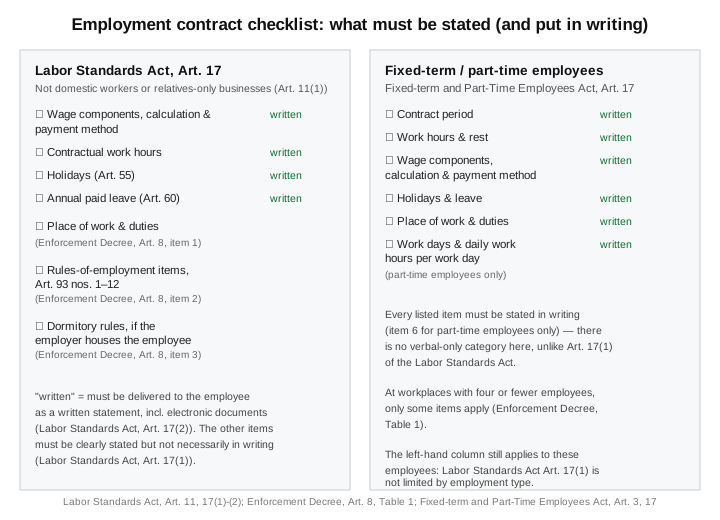
Sources: Labor Standards Act, Article 17(1)-(2); Enforcement Decree of the Labor Standards Act, Article 8; Act on the Protection, etc. of Fixed-term and Part-time Employees, Article 17.
Penalties for getting this wrong
The two laws attach different kinds of penalties to a violation of these terms, and the difference matters for how seriously an employer should treat each one.
Under the Labor Standards Act, a person who violates Article 17 — among a list of other articles — is subject to a fine not exceeding ₩5,000,000 (Labor Standards Act, Article 114(1)). This is a criminal fine (벌금), not an administrative penalty. Article 114 covers the whole of Article 17, so it reaches both the clear-statement duty under Article 17(1) and the written-delivery duty under Article 17(2).
Under the Act on the Protection, etc. of Fixed-term and Part-time Employees, a person who violates Article 17 by failing to state the required terms in writing is subject to an administrative fine (과태료) not exceeding ₩5,000,000, assessed and collected by the Minister of Employment and Labor (Act on the Protection, etc. of Fixed-term and Part-time Employees, Article 24(2)(2), (3)). An administrative fine is a different kind of sanction from a criminal fine, even though the ceiling amount, ₩5,000,000, happens to be the same figure as the Labor Standards Act fine.
For a fixed-term or part-time employee, the two duties are separate: the criminal fine attaches to Article 17 of the Labor Standards Act, and the administrative fine attaches to the written-statement duty in Article 17 of the Fixed-term and Part-time Employees Act. How the two sanctions interact when one omission breaches both is not addressed in the provisions reviewed for this article.
Three common misunderstandings
“Everything in the contract has to be in writing.” Not under the Labor Standards Act alone. For a regular employee, only four items — wage components and calculation/payment method, work hours, holidays, and annual leave — carry a written-delivery duty under Article 17(2). The place of work and duties, the applicable rules-of-employment items, and dormitory rules (the Enforcement Decree Article 8 items) only have to be clearly stated under Article 17(1); the statute does not require them to be delivered as a written statement the way it does the other four. Many employers put everything in writing anyway as good practice, but that is a choice, not something Article 17(2) itself requires for those items.
“The written-contract rule is the same no matter the employee.” It is not. A fixed-term or part-time employee is covered by a second, stricter law — the Act on the Protection, etc. of Fixed-term and Part-time Employees — that requires each of its listed items in writing, with no verbal-only category. A regular, indefinite-term, full-time employee is not covered by that second law’s Article 17; only the narrower Labor Standards Act written-delivery duty (four items) applies. Using one contract template for every hire, without checking whether the employee is fixed-term or part-time, risks missing the extra written items — and the separate administrative-fine exposure — that only apply to that second group.
“A fine for one violation means the same kind of penalty as a fine for the other.” The Labor Standards Act fine for an Article 17 violation is a criminal fine (벌금). The Fixed-term and Part-time Employees Act fine for an Article 17 violation is an administrative fine (과태료). Both are capped at ₩5,000,000, and the two amounts being identical is easy to read as meaning the two penalties are interchangeable. They are not the same category of sanction, and a single contract can breach both duties.
A note on translations: the official English translation of the Labor Standards Act reflects the October 22, 2024 promulgation. Article 17, and the fine of up to ₩5,000,000 that Article 114 sets for violating it, read the same in the Korean text effective August 20, 2026 and in the amendment effective October 8, 2026; a further change to Article 114 effective December 8, 2026 only removes Article 103 from its list. The Enforcement Decrees have no official English translation, and the English wording used here for Article 24 of the Fixed-term and Part-time Employees Act is our rendering of the Korean text.
A note on what this article does not cover
This article covers the statutory list of required and written-form terms only. It does not cover the Ministry of Employment and Labor’s standard employment contract template (표준근로계약서), the practical scope of electronic-contract acceptance beyond the bare statutory reference to the Framework Act on Electronic Documents and Transactions, or how Ministry guidance interprets any of these provisions in practice — Ministry of Employment and Labor guidance, not covered here.