In short: Industrial accident insurance in Korea covers every employee at a covered workplace, with no nationality condition written into the coverage provision (Industrial Accident Compensation Insurance Act, Article 6). Getting a benefit paid, however, is not automatic. First, the injury, disease, disability, or death has to meet one of the recognition standards set out in Article 37. Second, it has to fall into one of eight categories of insurance benefits (Article 36(1)). Third, the entitled person has to file a claim (Article 36(2)) — and that claim right expires if it is not exercised within 3 years, or 5 years for a specific set of benefits (Article 112(1)). This article works through these steps (recognition, benefit category, filing, and the claim deadline) using the text of the Act, together with the filing steps the Korea Workers’ Compensation & Welfare Service publishes.
Who is protected: no nationality condition in the text
The Act’s coverage provision is short: it applies to every business or workplace that employs employees, and the only carve-out is for businesses that Presidential Decree excludes because of their risk rates, size, or location (Industrial Accident Compensation Insurance Act, Article 6). Nothing in that Article conditions coverage on the employee’s nationality or residence status.
“Employee” itself is not separately defined for purposes of the Act — Article 5(2) borrows the term directly from the Labor Standards Act: “employee,” “wage,” “average wage,” and “ordinary wage” mean whatever those terms mean under the Labor Standards Act (Industrial Accident Compensation Insurance Act, Article 5(2)). So whoever counts as an employee under the Labor Standards Act counts as an employee here, without a separate nationality test layered on top.
The word “foreigner” appears only twice in the Act — in the Service’s power to borrow funds, including from foreigners (Article 27(1)), and in its power to request data such as foreigner registration records (Article 31(1)) — and neither is a coverage rule. The Act does, however, treat non-Korean nationals who live abroad differently for some benefits: a worker who is not a Korean national and lives abroad when the disability-benefit claim arises receives a lump sum rather than an annuity (Article 57(3)), and survivors who were not Korean nationals and lived abroad at the time of death are excluded from the survivors’ annuity (Article 63(1)). A non-Korean national receiving a disability annuity, or qualifying for a survivors’ annuity, loses that right on leaving Korea to live abroad (Articles 58, item 3, and 64(1)7), and a non-Korean worker who leaves the country before treatment ends may apply to receive the benefits expected after treatment stops in a single lump sum (Article 76(1)). None of these provisions adds a nationality condition to coverage under Article 6.
Step 1: does the injury, disease, or death count as an “occupational accident”? (Article 37)
Before any benefit is on the table, the injury, disease, disability, or death has to be recognized as an occupational accident. Article 37(1) sorts the recognized causes into three groups, with a general qualifier: even if the accident falls into one of the listed categories, it is not treated as an occupational accident if there is no proximate causal relation between the employee’s duties and the accident (Industrial Accident Compensation Insurance Act, Article 37(1), proviso).
1. Accident on duty. This category covers: an accident while performing a duty under the employment contract or an act incidental to it; an accident caused by a defect or careless management of a facility the business owner provided; an accident during an event sponsored by, or under the direction of, the business owner, or while preparing for one; an accident during a recess that occurs from an act deemed to be under the business owner’s control and management; and, as a catch-all, any other accident occurring in connection with the employee’s duties (Article 37(1)1). Item (c) of this list was deleted in 2017 (Act No. 14933), following a September 29, 2016 Constitutional Court decision of nonconformity to the Constitution.
2. Occupational disease. This category covers a disease caused by handling or exposure to a physical agent, chemical substance, dust, pathogen, work that burdens the body, or any other health-damaging factor encountered while performing duties; a disease caused by an occupational injury; a disease caused by work-related mental stress from workplace harassment under Article 76-2 of the Labor Standards Act or from verbal abuse by customers; and, again, a catch-all for any other disease caused in connection with the employee’s duties (Article 37(1)2).
3. Accident on commuting. This category covers an accident while commuting using a transportation means the business owner provided (or an equivalent means under the business owner’s control and management), and an accident while commuting by the ordinary route and method (Article 37(1)3). For the second type — the ordinary-route case — if the employee deviates from or suspends the commute, an accident occurring during that deviation or suspension, or during the movement afterward, is not treated as an accident on commuting. The exception to that exception: if the deviation or suspension is a daily-life necessity of a kind that Presidential Decree specifies, the accident on commuting recognition still applies (Article 37(3)). Separately, Presidential Decree can define types of work with no regular commuting route or method, and for those, the ordinary-route accident-on-commuting rule does not apply at all (Article 37(4)). Presidential Decree sets the specific grounds and job types under Articles 37(3) and (4).
Two exclusions apply across all three categories. First, an injury, disease, disability, or death caused by the employee’s own intentional act, self-harm, or a criminal act — or caused by such an act — is not an occupational accident, unless the act was committed in a state of markedly diminished normal cognitive function for a reason Presidential Decree specifies, in which case it is still treated as one (Article 37(2)). Second, the detailed recognition standards beyond what Article 37 itself sets out are left to Presidential Decree (Article 37(5)).
Step 2: which benefit category applies? (Article 36)
Once an occupational accident is recognized, Article 36(1) sets out eight categories of insurance benefit:
- Medical care benefits
- Temporary layoff benefits
- Disability benefits
- Nursing benefits
- Survivors’ benefits
- Injury and disease compensation pensions
- Funeral expenses
- Vocational rehabilitation benefits
Two groups get a narrower list. For pneumoconiosis, the available benefits are limited to medical care benefits, nursing benefits, funeral expenses, vocational rehabilitation benefits, the pneumoconiosis compensation annuity under Article 91-3, and the pneumoconiosis survivors’ annuity under Article 91-4. For a health-impaired child covered under Article 91-12, the available benefits are limited to medical care benefits, disability benefits, nursing benefits, funeral expenses, and vocational rehabilitation benefits (Article 36(1), proviso).
The Act also sets how the average wage used to calculate these benefits moves over time: after one year from the date the calculation ground arises, the average wage rises or falls each year with the fluctuation rate of all employees’ average wages, and after the employee turns 60, it instead tracks the consumer price index (Article 36(3); this indexing does not apply to pneumoconiosis benefits calculated under Article 36(6)). And it sets a ceiling and a floor: for all benefits other than funeral expenses, if the average wage that would otherwise apply exceeds 1.8 times the average wage of employees at businesses with 5 or more regular employees, that 1.8-times figure — the “maximum standard amount of compensation” — is used instead; if it falls under half of that figure, the “minimum standard amount of compensation” applies instead, except that the minimum standard amount of compensation itself cannot go below 8 times the statutory hourly minimum wage, and it is not applied at all when calculating temporary layoff benefits or injury and disease compensation pensions (Article 36(7)). The actual annual figures for the maximum and minimum standard amounts, and for the two fluctuation rates, are calculated by methods set by Presidential Decree and publicly notified each year by the Minister of Employment and Labor (Article 36(4), (8)).
Step 3: filing the claim (Article 36(2))
None of the eight benefit categories is paid automatically. Article 36(2) states that insurance benefits are paid upon request from the person entitled to receive them — called the “beneficiary” — meaning a person entitled to the benefit under the benefit-specific provisions that Article 36(2) lists (Articles 40, 52–57, 60–62, 66–69, 71, 72, 91-3, and 91-4). Recognition of an occupational accident under Article 37 establishes that the accident qualifies; it does not by itself put a payment in motion. The claim itself has to be filed.
For medical care benefits, the Korea Workers’ Compensation & Welfare Service describes the steps this way: after emergency treatment (checking whether the hospital is a designated industrial accident insurance medical institution), the worker fills in a medical care benefit application (요양급여신청서) and submits it to the Service. The application sets out the workplace, how the accident happened, and the medical opinion on it (Article 41(1)). A designated medical institution that treated the worker and judges the accident to be occupational may file the application on the worker’s behalf, with the worker’s consent (Article 41(2)). The Service states that, where it is clear that the injury arose from work, it notifies whether care is approved within 7 days, and that cases needing a site investigation, special medical examination, or epidemiological study can take longer. If a benefit decision goes against you, a request for review can be filed with the Service, through the branch that made the decision, within 90 days of learning of the decision (Article 103(2)–(3)). Where the decision went through the Occupational Disease Adjudication Committee, you may skip that review and file a request for re-examination with the Industrial Accident Compensation Insurance Re-examination Committee directly, also within 90 days of learning of the decision (Article 106(1) proviso and (3) proviso). The Service’s page also notes that an administrative lawsuit can be filed with the competent administrative court instead. The Service’s main number is 1588-0075.
Step 4: the claim deadline — prescription (Article 112)
A claim right does not stay open forever. Article 112(1) sets two different prescription periods, depending on which right is being exercised:
- 3 years is the default period for a right that is not exercised. This covers the entitlement to insurance benefits generally under Article 36(1) — in practice, medical care, temporary layoff, nursing, injury-disease compensation pension, and vocational rehabilitation benefits fall under this default, since the Article carves out a separate, longer period for specific benefits (see below). The 3-year default also applies to four other rights listed in the same Article: the right of an industrial accident insurance-related medical institution under Article 45, the right of a pharmacy under Article 46, the right of a policyholder under Article 89, and the right of the National Health Insurance Corporation, etc. under Article 90(1).
- 5 years applies specifically to the entitlement to disability benefits, survivors’ benefits, funeral expenses, the pneumoconiosis compensation annuity, and the pneumoconiosis survivors’ annuity (Article 112(1), proviso).
Once the applicable period runs without the right being exercised, the right is extinguished by prescription (Article 112(1)). For anything Article 112 itself does not cover, the Civil Act governs extinctive prescription (Article 112(2)). Under Article 113, filing a claim under Article 36(2) interrupts the Article 112 prescription period, and where it is the first claim that requires a decision on whether the accident is occupational, the interruption also extends to the other insurance benefits listed in Article 36(1).
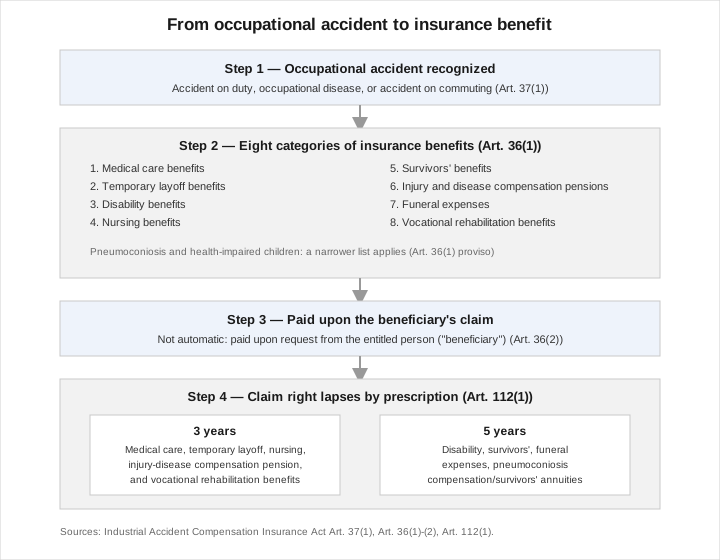
Sources: Industrial Accident Compensation Insurance Act, Articles 37(1), 36(1)-(2), and 112(1).
Assumptions that don’t match the Act
“The insurance only covers accidents that happen on the factory floor or at a desk.” The recognition standards in Article 37 reach well beyond the workplace itself: company-sponsored events and the preparation for them, employer-controlled recess activity, and commuting on the ordinary route or on employer-provided transportation can all qualify as occupational accidents in their own right, alongside the core case of an accident during the performance of duties (Article 37(1)1, 3).
“If I’m hurt, the payment comes automatically once the accident is recognized as work-related.” Recognition under Article 37 and payment under Article 36 are two separate steps. The insurance benefit is paid only upon request from the beneficiary (Article 36(2)); recognizing that an accident is occupational does not, by itself, start payment.
“The claim deadline is the same for every kind of benefit.” It is not. The Act splits the claim right into a 3-year default and a 5-year period for disability benefits, survivors’ benefits, funeral expenses, and the two pneumoconiosis annuities (Article 112(1)). Treating every benefit as having the same deadline risks losing a right that a person assumed still had time left.
A note on translation timing: the official English translation of the Industrial Accident Compensation Insurance Act used for this article reflects the November 11, 2025 promulgation, while the Korean text now in force was promulgated February 19, 2026 and took effect July 1, 2026; Articles 5, 36, 37, and 112 were compared against the current Korean text and the gap did not affect their content, and Article 6 was checked against the current Korean text.