In short: The National Pension lump-sum refund (반환일시금) pays back an insured person’s contributions, plus interest, when coverage ends without producing a pension. For foreign insured persons, the rule runs the opposite way from what many assume: Article 126(5) of the National Pension Act shuts foreigners out of the lump-sum refund provisions as the default, and then carves back in only three specific groups. A social security agreement with your home country, where one exists, governs the matters it covers instead of the Act (Article 127).
This article covers only the lump-sum refund. For whether National Pension enrollment itself is mandatory for a foreign employee in the first place, and how that compares with Korea’s other social insurances, see the four social insurances for foreign employees.
What the lump-sum refund is
A lump-sum refund (반환일시금) is a one-time payment of an insured or formerly insured person’s National Pension contributions, made when their coverage ends in a way that does not produce a recurring pension. It is paid on request — either by the person themselves or by their survivors — when one of three grounds under Article 77(1) of the National Pension Act is met:
- A person whose period of coverage is under 10 years reaches age 60;
- An insured person or former insured person dies, unless a survivors’ pension is instead paid under Article 72; or
- The person loses their nationality or emigrates abroad.
(National Pension Act, Article 77(1))
The amount is not a flat refund of contributions alone. It is the pension contributions the person paid — including the employer’s contribution, if the person was a workplace-based insured person — plus interest set by Presidential Decree (National Pension Act, Article 77(2)). That interest is not a fixed percentage written into the statute. Under the Enforcement Decree, it is calculated for the period from the month after each contribution was paid up to the month the payment ground arose, using the three-year time-deposit interest rate; where that rate changes during the calculation period or differs between banks, the rate applied is the average of the rates applied, as of January 1 of each year, by banks established under the Banking Act that operate nationwide (Enforcement Decree of the National Pension Act, Article 50).
When a claim is made by survivors rather than the insured person themselves, the scope of who counts as a survivor and the order of priority among them follows the same rules that apply to survivors’ pension claims (National Pension Act, Article 77(3), applying Article 73 mutatis mutandis). If two or more survivors of the same priority rank are entitled to claim, the method of payment among them also follows the rule used for survivors’ pensions (Enforcement Decree of the National Pension Act, Article 51).
The age-60 threshold does not move with the pension-age increase
One detail is easy to get wrong. For other National Pension benefits, the payment ages in a list of benefit provisions are raised by one to five years depending on birth year (Addenda No. 8541, Article 8). The lump-sum refund is different. A specific addenda provision states that, notwithstanding the general age-increase special provision, a person whose coverage period is under 10 years can still receive the lump-sum refund at age 60 (Addenda No. 8541 of July 23, 2007, Article 8-3). In other words, the “age 60” in Article 77(1)(1) stays at 60 regardless of the birth-year schedule that pushes back other benefits.
Foreigners are excluded from the lump-sum refund by default
Article 126 of the National Pension Act sets the general framework for how the Act applies to foreigners. Under its main provision, a foreigner who is employed at a workplace covered by the Act, or who resides in Korea, becomes a workplace-based insured person or an individually insured person as a matter of course — subject to a category the Presidential Decree excludes, and subject to a separate proviso that this does not apply if the foreigner’s home-country law does not extend an equivalent pension to Korean nationals (National Pension Act, Article 126(1)). A foreigner who is currently insured, or was previously insured, under this provision is referred to in the Act as a “foreign insured person, etc.” (National Pension Act, Article 126(3)).
For this same group, Article 126(5) then states the rule that matters most for the lump-sum refund: Articles 77 through 79 do not apply to foreign insured persons, etc. — meaning that, as a general rule, a foreign insured person cannot receive a lump-sum refund even if they meet one of the three payment grounds in Article 77(1) described above (National Pension Act, Article 126(5)).
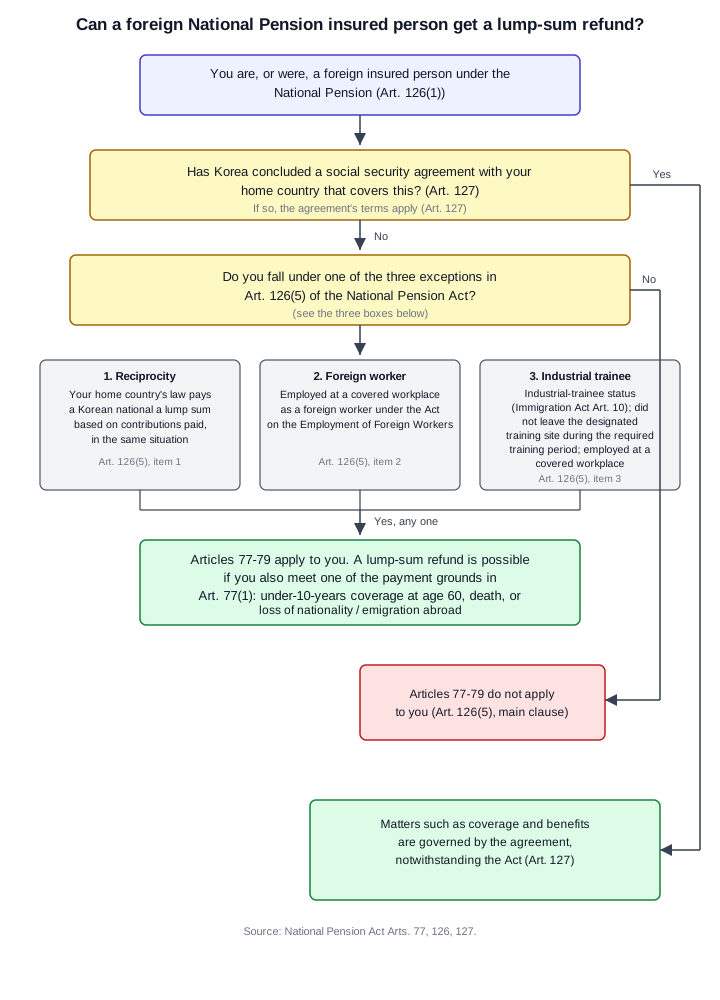 Source: National Pension Act Articles 77, 126, and 127.
The three exceptions
The same Article 126(5) then restores eligibility for three specific groups, each defined in its own subparagraph:
1. The reciprocity exception. If, under the foreigner’s home-country law, a Korean national who falls into one of the Article 77(1) grounds would not acquire a pension-type benefit there, but that country’s law instead provides for paying that Korean national a lump sum calculated from the contributions paid during their coverage period — then the foreigner is entitled to the same treatment here (National Pension Act, Article 126(5), item 1). This is a mirror-image test: it looks at what the foreigner’s home country would do for a Korean national in the reverse situation, not at whether Korea has a treaty with that country.
2. Foreign workers under the Act on the Employment of Foreign Workers. A foreign worker covered by that Act who is employed at a workplace subject to the National Pension Act remains eligible for the lump-sum refund (National Pension Act, Article 126(5), item 2).
3. Industrial trainees under the Immigration Act. A person who holds a status of stay permitting industrial training activities under Article 10 of the Immigration Act, who has not left the designated training site during the required training period, and who is employed at a workplace subject to the National Pension Act, is also eligible (National Pension Act, Article 126(5), item 3).
Unless a social security agreement provides otherwise (Art. 127), a foreign insured person who does not fall into any of these three groups has no lump-sum refund route under Articles 77-79, even if they meet one of the Article 77(1) payment grounds (age 60 with under 10 years of coverage, death, or loss of nationality / emigration).
It is worth separating this refund-eligibility test from a different reciprocity clause in Article 126(1) — the proviso that determines whether a foreigner is mandatorily enrolled in the National Pension at all in the first place, based on whether their home country extends an equivalent pension to Korean nationals. That is a threshold question about enrollment. Article 126(5), item 1’s reciprocity test is a separate, narrower question about the lump-sum refund specifically, asked only after enrollment is already established. The two provisions use similar reasoning but answer different questions.
Separately, not every foreigner residing or working in Korea is even swept into mandatory National Pension coverage in the first place. The Enforcement Decree excludes several categories from the “as a matter of course” enrollment in Article 126(1) — for example, a person staying without an extension-of-stay permit under the Immigration Act, a person who has not completed alien registration or who has been issued a deportation order, and holders of certain status-of-stay categories designated by Ministry of Health and Welfare rule (Enforcement Decree of the National Pension Act, Article 111). A person excluded at this earlier stage is not a “foreign insured person” to begin with, so the Article 126(5) refund question does not arise for them.
The October 20, 2026 amendment also added two limits for foreign nationals outside the refund question. A foreign recipient is not paid the dependants’ supplement under Article 52 (for a survivors’ pension, the deceased insured person or former insured person) unless the home country’s law pays a corresponding supplement and applies that rule to Korean nationals, or the person is a foreign national designated by Presidential Decree (National Pension Act, Article 126(2)); it applies to pension entitlements arising on or after October 20, 2026; for a foreign recipient outside the exceptions whose entitlement arose earlier, a spouse, child, or parent who newly qualifies on or after that date is not added to the supplement (Addenda Art. 4(1)–(2)). A foreign insured person also cannot make a late payment of contributions under Article 92, with the same two kinds of exception (Article 126(6); Addenda Article 5(1)). The Presidential Decree exceptions in both paragraphs take effect on April 21, 2027; the rest took effect on October 20, 2026 (Addenda Article 1).
When a social security agreement takes over
Article 127 of the National Pension Act adds one more layer that can override everything above. If Korea has concluded a social security agreement with a foreign country, then — notwithstanding the Act — matters including coverage under the National Pension, payment of pension contributions, eligibility requirements for benefits, calculation of benefit amounts, and payment of benefits are governed by that agreement instead (National Pension Act, Article 127).
That means for a national of a country with such an agreement, the lump-sum refund framework in Articles 77, 126, and 127 described above may not be the operative rule at all — the agreement’s own terms take precedence. Social security agreements commonly use a different mechanism than a lump-sum refund, such as totalizing (aggregating) periods of coverage across the two countries so a person qualifies for a pension in one or both systems instead of receiving a refund. The list of countries that have concluded such an agreement with Korea, and each agreement’s terms, are published separately rather than in the National Pension Act itself.
How to apply
The National Pension Service (NPS) lists four ways to file a lump-sum refund claim: its website, its mobile service, a visit to an NPS branch, or fax. Branch staff review each claim after it is filed and may ask for additional documents. Where you also have periods of residence abroad or of coverage under a foreign pension scheme, the NPS asks you to consult the branch after filing. The NPS customer center number is 1355.
Three common misunderstandings
“Any foreigner who leaves Korea for good gets their contributions back.” This gets the default backwards. Article 126(5) makes non-eligibility the general rule for foreign insured persons, not eligibility. Losing your nationality or emigrating abroad is one of the payment grounds under Article 77(1), but meeting that ground only matters if you first fall into one of the three exceptions in Article 126(5) — or if a social security agreement puts you on a different track altogether.
“The refund includes a fixed, published interest rate.” The interest added to the returned contributions is not a flat statutory number. It tracks the three-year time-deposit interest rate, and where that rate changes during the calculation period or differs between banks, the rate used is the average applied by nationwide banks as of January 1 of each year, so the effective rate differs depending on when the contributions were paid and when the payment ground arose (Enforcement Decree of the National Pension Act, Article 50).
“The age-60 requirement will rise for me the same way the old-age pension age is rising.” It will not. A specific addenda provision keeps the lump-sum refund’s age-60 threshold fixed, exempting it from the general schedule that gradually raises the starting age for other National Pension benefits by birth year (Addenda No. 8541 of July 23, 2007, Article 8-3).
A note on translations: the official English translation of the National Pension Act reflects the May 26, 2026 amendment, while the Korean text now in force reflects the October 20, 2026 amendment, which reorganized Article 126; paragraphs (2)-(4) of Article 126 in the English version correspond to paragraphs (3)-(5) of the current Korean text cited here. The descriptions of the Enforcement Decree provisions cited above (Articles 50, 51, and 111) are based on the Korean text.