In short: A foreign driver’s license does not, on its own, let you drive in Korea. You need either an International Driving Permit (or a mutually recognized foreign license) issued under an international convention or a bilateral agreement, which is valid for one year from the date you enter Korea, or you need to exchange your foreign license for a Korean one. The exchange route requires meeting a residency-status condition, and the tests you’re exempted from during that exchange depend on whether your issuing country is one Korea has designated as recognizing Korean licenses.
Driving on an international driving permit — Article 96
The Road Traffic Act allows a specific category of document — not a plain foreign license — to be used for driving in Korea without any exchange or Korean testing at all. Article 96(1) covers two kinds of documents:
- A driving license issued by a foreign competent authority under one of three international instruments: the 1949 Geneva Convention on Road Traffic, the 1968 Vienna Convention on Road Traffic, or a convention, treaty, or agreement between Korea and a foreign country for mutual recognition of international driving permits (Road Traffic Act, Article 96(1)1-3). This is what the law calls an “international driving permit.”
- A foreign driver’s license recognized under a convention, treaty, or agreement between Korea and a foreign country for mutual recognition of each other’s licenses (Road Traffic Act, Article 96(1)4). The law calls this a “mutually recognized foreign driver’s license.”
A holder of either document can drive a motor vehicle in Korea for one year from the date of entry into the country, without needing a Korean driver’s license at all. The types of vehicle you can drive are limited to whatever is stated on the permit itself (Road Traffic Act, Article 96(1)).
Article 96(1) counts this one-year window from the date of entry into Korea. The Act does not set the permit’s own validity period, so also check the expiry date printed on the permit. Beyond that, driving requires a Korean driver’s license, obtained by exchange (see below) or by taking the Korean test.
There are two further limits built into Article 96 itself:
- No commercial driving. A person driving on an international driving permit or a mutually recognized foreign license cannot drive a commercial vehicle under the Passenger Transport Service Act or the Trucking Transport Business Act. The one exception is a rental vehicle under the Passenger Transport Service Act that the person has leased themselves (Road Traffic Act, Article 96(2)).
- Disqualification still applies. If you fall under one of the license-disqualification grounds in Article 82(2) of the Road Traffic Act, you may not drive under Article 96(1) even if you hold a valid international driving permit (Road Traffic Act, Article 96(3)). If you’re researching how a drunk-driving conviction affects a Korean license, our separate article on drunk-driving penalties covers the criminal and license-revocation rules that feed into this kind of disqualification.
It’s worth keeping Article 96 separate in your mind from the next section. Article 96 lets you drive on your existing foreign document, temporarily, without ever holding a Korean license. Exchanging your license under Article 84 is a different, one-time process that ends with you holding an actual Korean driver’s license.
One more document worth distinguishing: Article 98 of the Road Traffic Act covers the reverse situation — a person who already holds a Korean driver’s license applying to a Korean Metropolitan or Provincial Police Agency for an international driving permit to use abroad (Road Traffic Act, Article 98(1)). That permit is valid for one year from issuance (Article 98(2)), loses effect if the holder’s Korean license is revoked (Article 98(3)), and is suspended for as long as the underlying Korean license is suspended (Article 98(4)). It has nothing to do with using a foreign license inside Korea — it’s the Korea-to-abroad direction, not the abroad-to-Korea direction this article is about.
Exchanging a foreign license for a Korean one — Article 84 and Enforcement Decree Article 52
If you plan to stay in Korea beyond the one-year window, or simply want a Korean driver’s license rather than relying on a foreign document, the Road Traffic Act provides a path to exchange a foreign license for a Korean one with part of the standard test waived.
Who qualifies. Article 84(1)3 grants a partial test exemption to a person who holds a driver’s license issued by a competent authority of a foreign country (a “foreign license”) and who also falls into one of these categories:
- A person registered as a resident under Article 6 of the Resident Registration Act (Road Traffic Act, Article 84(1)3(a));
- A registered foreigner under Article 31 of the Immigration Act, or a person exempt from foreigner registration (Road Traffic Act, Article 84(1)3(b));
- A person recognized as a refugee under the Refugee Act (Road Traffic Act, Article 84(1)3(c));
- A person who has reported a domestic residence under Article 6 of the Act on the Immigration and Legal Status of Overseas Koreans — an “overseas Korean” (Road Traffic Act, Article 84(1)3(d)).
What the foreign license itself has to be. Article 84(2) adds a condition on the foreign license: it has to be one obtained in the issuing country while staying there for a period exceeding 90 days during that stay, and it cannot be a temporary license or a learner’s license. The Enforcement Decree of the Road Traffic Act, Article 52(1), repeats this same definition when it sends the exemption details to Attached Table 3 (Enforcement Decree of the Road Traffic Act, Article 52(1)).
How much of the test is waived. This is where the exemption splits into two tracks, depending on whether your issuing country is a “country recognizing domestic license” — a country that exempts holders of a Korean driver’s license from every course of its own driver’s license test except the aptitude test (Road Traffic Act, Article 84(2)). Attached Table 3 to the Enforcement Decree sets out the difference:
- If your foreign license was issued by a country that recognizes Korean licenses this way, you are exempted from the functional test, the written (law) test, the vehicle inspection, and the road-driving test when applying for a Category 2 ordinary license (Enforcement Decree of the Road Traffic Act, Article 52 and Attached Table 3, item 2). KoROAD applies one exception in practice: licenses from Oregon, Idaho, Utah, and Nevada in the United States still take the written test (see “How to apply in practice” below).
- If your foreign license was issued by a country that does not recognize Korean licenses this way, you are exempted only from the functional test and the road-driving test when applying for the same Category 2 ordinary license (Enforcement Decree of the Road Traffic Act, Article 52 and Attached Table 3, item 3).
Both tracks exclude motorcycle and moped licenses — Attached Table 3’s foreign-license items apply to ordinary automobile licenses, not two-wheeled vehicle categories (Enforcement Decree of the Road Traffic Act, Article 52 and Attached Table 3).
Who decides which countries “recognize” Korean licenses, and how you find out. This isn’t something written into the statute as a fixed list. The Minister of Foreign Affairs surveys, at least once a year, which countries exempt Korean-license holders from every test course except the aptitude test, and reports the results to the Commissioner General of the Korean National Police Agency (Road Traffic Act, Article 84(2); Enforcement Decree of the Road Traffic Act, Article 52(3)). The Commissioner General then confirms the scope of recognized countries and issues a public notice (Enforcement Decree of the Road Traffic Act, Article 52(4)). In other words, the current list of which countries fall into which track is set by public notice from the Korean National Police Agency, not by the Road Traffic Act itself.
A special case for diplomats, officials, and researchers. Article 84(2)’s proviso says that a foreign license held by a person residing in Korea for a purpose set by Presidential Decree — such as diplomacy, official duty, or research — is treated as if it were issued by a country that recognizes Korean licenses, regardless of where it actually came from. The Enforcement Decree spells out exactly which visa statuses this covers: diplomatic, official, agreement, resident (주재), corporate investment, trade management, professor, research, technical guidance, or specific-activity status under the Enforcement Decree of the Immigration Act’s Attached Tables 1 and 1-2, plus overseas Koreans — and it extends to the spouse and any unmarried child under 19 of a person holding one of those statuses (Enforcement Decree of the Road Traffic Act, Article 52(2)). If Korea also has a specific license-recognition agreement with a “recognizing” country, part of the test may be exempted according to that agreement (Road Traffic Act, Article 84(2)).
Can they keep your foreign license? When the Korea Road Traffic Authority exchanges a foreign license and issues a Korean one under this process, it generally does not keep the original foreign license. It may retrieve it only in specific situations set by Presidential Decree: where the country that issued the foreign license requests its return, or where that country itself retrieves a person’s Korean license when issuing them a foreign one (Road Traffic Act, Article 84(3); Enforcement Decree of the Road Traffic Act, Article 52(5)). Where the issuing country’s authorities request it, the retrieved license can be sent back to them (Road Traffic Act, Article 84(3)).
How to apply in practice. Eligibility and the test waivers come from Article 84 of the Road Traffic Act and Article 52 of its Enforcement Decree; the current documents and fees are listed in the Korea Road Traffic Authority’s (KoROAD) exchange guide. You apply in person at a driver’s license test site in Korea; proxy filing is not accepted, except for holders of an ID issued by the Minister of Foreign Affairs. For a registered foreigner, the guide lists the original foreign license; the original passport showing your exits and entries; the original alien registration card (or domestic residence report card for overseas Koreans); three color passport photos taken within 6 months (3.5 cm × 4.5 cm); an embassy confirmation of the license or an apostille certificate issued within 1 year before the application date; and a certificate of entry and exit records covering everything from your date of birth to the present. Members of the U.S. Forces Korea on A-3 status have a separate document list in the same guide. KoROAD reviews the documents first and may ask for more if something is missing, then runs the aptitude (physical) test, plus a 40-question multiple-choice written test if your license is treated as coming from a country that does not recognize Korean licenses; the written test can be taken in Korean, English, Chinese, or Vietnamese. The issuance fee is ₩10,000 for a standard card or ₩15,000 for a mobile IC card, either in Korean or English; the written test, where required, costs a further ₩10,000, and the physical exam is charged separately (₩7,000 for most licenses). Exchange applications must be received by 17:00, and KoROAD recommends arriving before 16:00 if you need the written test. Six test sites (Mungyeong, Gangneung, Taebaek, Gwangyang, Chungju, and Chuncheon) have no physical exam center on site, so applicants there take the physical exam at a nearby hospital. KoROAD’s customer center is 1577-1120, and it offers foreign-language chat support through its KakaoTalk channel.
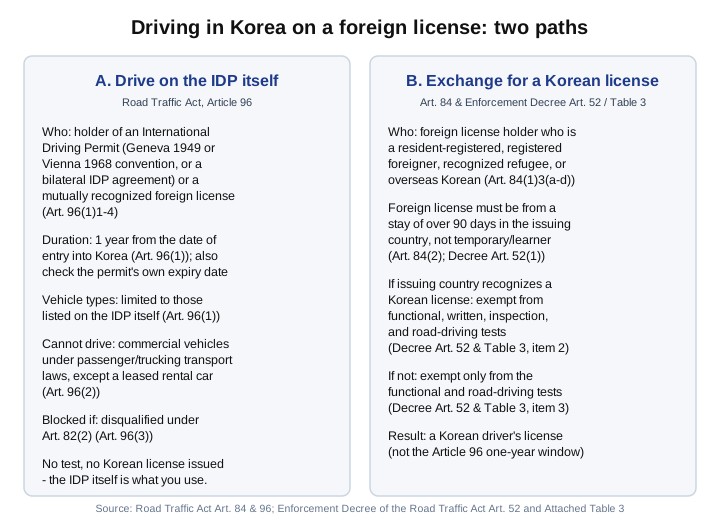
Sources: Road Traffic Act, Articles 84 and 96; Enforcement Decree of the Road Traffic Act, Article 52 and Attached Table 3.
Three common misunderstandings
“My home license works in Korea on its own, no permit needed.” It doesn’t. A plain foreign license by itself is not a lawful basis for driving in Korea. You need either an international driving permit or mutually recognized foreign license under Article 96(1), which is valid for a limited one-year window from your entry date, or you need to go through the Article 84 exchange process and actually hold a Korean license.
“The international driving permit lasts as long as my visa does.” It is not tied to your visa. Article 96(1) counts one year from the date you entered Korea; also check the expiry date printed on the permit. If you will drive beyond that, you need a Korean license.
“Exchanging my license means I skip the whole test.” Not necessarily. Which tests you skip depends on whether your issuing country is one recognized as exempting Korean-license holders from its own test courses. Under Attached Table 3, a recognized country’s license holder skips the functional, written, inspection, and road-driving tests, while a non-recognized country’s license holder only skips the functional and road-driving tests (Enforcement Decree of the Road Traffic Act, Article 52 and Attached Table 3) — the aptitude test is never skipped, and in the non-recognized case, the written test isn’t skipped either. KoROAD also has licenses from Oregon, Idaho, Utah, and Nevada take the written test.
A note on translation timing
The official English translation of the Road Traffic Act cited throughout this article was promulgated on January 21, 2025. The Korean text has been amended several times since, most recently by an Act promulgated on October 13, 2026 — so if you’re reading the English translation directly rather than this summary, be aware it may not yet reflect the most recent Korean amendments.