In short: when your lease ends but your landlord hasn’t paid back your deposit, the law treats the lease as still continuing until you’re repaid (Housing Lease Protection Act, Article 4(2)). But that legal fiction doesn’t protect you once you physically move out and lose your resident registration at that address — unless you first complete a leasehold registration order (임차권등기명령). Filing this with the court covering the house’s location, and getting it entered on the property’s register, lets you keep your opposing power and preferential repayment right even after you’ve moved somewhere else (Article 3-3(5)).
A note on translations: the Housing Lease Protection Act’s official English translation matches the Korean text in force, quoted below. The Rules on Procedure for Lease Registration Orders (임차권등기명령 절차에 관한 규칙), a Supreme Court Regulation, has no official English translation available — the quotations from it here are our translation of the Korean text in force as of this article’s last-checked date.
When a lease ends without the deposit being repaid
Ordinarily, a fixed-term lease simply ends on its expiration date, or earlier if both parties agree to terminate it or a statutory ground applies. What the Act adds is a rule for what happens if the deposit isn’t handed back at that point.
Article 4(2) states it plainly: “Even though the period for lease has expired, the relations of lease shall be deemed to continue until a deposit is repaid to a lessee” (Housing Lease Protection Act, Article 4(2)). In other words, non-payment of the deposit doesn’t just leave you with a breach-of-contract claim — it keeps the lease relationship itself alive, on paper, for as long as the deposit remains unpaid.
This matters because the tenant’s core protections — opposing power against a new owner, and preferential repayment ranking against other creditors if the house is sold — depend on the tenant continuing to meet the possession-and-registration requirements of Article 3(1), (2), or (3) (see how opposing power and the fixed date protect your deposit for how those requirements are first established). As long as the lease is deemed to continue and you haven’t moved out, those requirements stay satisfied and your protections stay intact. The problem arises the moment you do move out, or move your resident registration elsewhere, before the deposit is actually paid.
Suing for the deposit, and enforcing a judgment. If the landlord still won’t pay, the tenant can sue for return of the deposit. Once there’s a final and conclusive judgment (or an equivalent title to enforce) ordering repayment, the tenant can apply for auction of the leased house to satisfy it. Normally, a creditor applying for auction based on such a judgment would first have to fulfil or offer to fulfil any obligation owed in return (here, handing the house back) before enforcement can begin. Article 3-2(1) removes that precondition specifically for this situation: “Where the lessee… files an application for auction of the leased house based on the final and conclusive judgment on the lawsuit demanding the repayment of deposit or execution title corresponding thereto, the fulfillment or provision of opposite obligations shall not be the requirements for the commencement of enforcement, notwithstanding Article 41 of the Civil Execution Act” (Housing Lease Protection Act, Article 3-2(1)).
Ranking against other creditors. Separately, if the house is sold at a court auction or a tax-arrears public sale — whether initiated by the tenant or by someone else — a tenant who has met the Article 3(1)/(2)/(3) opposing-power requirements and obtained a fixed date on the lease contract is entitled to be repaid the deposit out of the sale proceeds ahead of junior right holders and other creditors (Housing Lease Protection Act, Article 3-2(2)). But actually collecting that money still requires handing the house over to the buyer: “No lessee shall be permitted to receive the deposit under paragraph (2) without delivering the leased house to the transferee thereof” (Article 3-2(3)).
Put together, these two provisions describe the ordinary path to getting a deposit back after a dispute: sue, obtain judgment, and either get paid directly or force an auction and collect from the proceeds in your ranked position — handing back the house at the point of actual payment. The leasehold registration order exists for tenants who need to move out before that process is finished, without losing their place in that ranking.
The leasehold registration order: locking in your position before you move
When you can apply. The order is available only after the lease has actually ended and the deposit still hasn’t been returned: “If no deposit is refunded after the termination of a lease, the lessee may file an application for a leasehold registration order with the district court, the branch of the district court, or the Si/Gun court having jurisdiction over the location of the leased house” (Housing Lease Protection Act, Article 3-3(1)). You cannot use this procedure while the lease is still running, even if you anticipate trouble getting your deposit back later.
What the application must contain. Article 3-3(2) requires the application to state the purport of and reasons for the request, a description of the house (with a floor plan attached if the lease covers only part of it), and the facts constituting the grounds for the registration — including, if the tenant has already obtained opposing power under Article 3(1)/(2)/(3) or preferential repayment right under Article 3-2(2), the facts establishing that (Article 3-3(2)). The Supreme Court Regulation implementing this fills in further detail: the application must also state the case designation, the names, addresses, and (for individuals) resident registration number of tenant and landlord, the amount of deposit and rent not yet returned, the attachments, the date, and the court (Rules on Procedure for Lease Registration Orders, Article 2(1)). The stated reasons must cover the fact that a lease contract was made, its content, and how it came to end; a tenant who already has opposing power must state the date possession began and the date resident registration was completed, and a tenant who already has preferential repayment right must also state the date the fixed date was obtained (Rule, Article 2(2)). The application requires a ₩2,000 revenue stamp (Rule, Article 2(3)).
Documents to attach. The Rule also lists required attachments: a certified copy of the register if the house is registered in the landlord’s name, or a document proving that registration of ownership in the landlord’s name can be made immediately if it isn’t yet registered; the lease contract document; where the tenant has already obtained opposing power, documents substantiating the date possession began and the date resident registration was completed; where the tenant has already obtained preferential repayment right, those documents plus a lease contract document made as a notarized deed or bearing a fixed date; and, if the register shows a use other than residential, documents proving the house has been used as a residence from the time the lease was signed to the present (Rule, Article 3).
Procedure. The court’s decision on the application is made by way of a ruling, which must be served on the parties (Rule, Article 4(1), (2)). Several procedural rules governing provisional seizure orders under the Civil Execution Act apply to the leasehold registration order proceedings as well — covering the trial on the application, the landlord’s objection to a ruling and the trial on that objection, an application to cancel the order and its trial, and execution of the order — with “provisional seizure” read as “registration of leasehold,” “creditor” as “lessee,” and “debtor” as “lessor” (Housing Lease Protection Act, Article 3-3(3)). If the application is rejected, the tenant may appeal (Article 3-3(4)).
When the order takes effect, and how registration happens. The order “takes effect when the decision is served on the landlord, or when the registration is entered under the proviso to Article 5” (Rules on Procedure for Lease Registration Orders, Article 4(3)). Article 5 explains that proviso: ordinarily, the court clerk must promptly attach a certified copy of the decision to a commission letter and commission the registrar to enter the leasehold registration once the decision has been served on the landlord — but “in the case of a housing leasehold registration order, the registration may be commissioned even before the decision is served on the landlord” (Rule, Article 5). In practice, this means a housing tenant does not necessarily have to wait for service on the landlord before the registration itself gets entered.
What you gain once registration is complete. This is the core protection: “Where the lessee completes the registration of leasehold following the execution of the leasehold registration order, he or she shall obtain the opposing power… and the preferential repayment right…; provided, where the lessee has already obtained the opposing power or the preferential repayment right before the registration of leasehold, the opposing power or the preferential repayment right shall be maintained as it is, and even if he has lost the requirements for opposing power… after the registration of leasehold, the opposing power or the preferential repayment right which he has already obtained shall not be lost” (Housing Lease Protection Act, Article 3-3(5)). In plain terms: if you already had opposing power and a fixed date before registering, completing the leasehold registration freezes that protection in place, so you can move out — and even lose your resident registration at that address — without losing what you’d already earned.
A limit that runs the other way. The protection this creates does not extend to whoever leases the house next. “The lessee who has leased a house, for which the leasehold registration is completed following the execution of the leasehold registration order… thereafter, shall not have the right to receive the preferential repayment under Article 8” (Article 3-3(6)) — meaning the small-deposit priority repayment right is unavailable to a tenant who moves in after the registration is already on the register.
Costs and who else can apply. The tenant may request the landlord to reimburse the expenses incurred in filing the application and completing the registration (Article 3-3(8)). Certain financial institutions that have succeeded to a tenant’s preferential repayment right may also file this application in the tenant’s stead — in which case references to “lessee” in the procedural, objection, and cost-reimbursement provisions are read as referring to that institution instead (Article 3-3(9)).
Where to file. The application goes to the district court, branch court, or city/county court with jurisdiction over the leased house (Article 3-3(1)). You can file online through the Supreme Court’s e-litigation portal (ecfs.scourt.go.kr) or submit the application to the competent court in person.
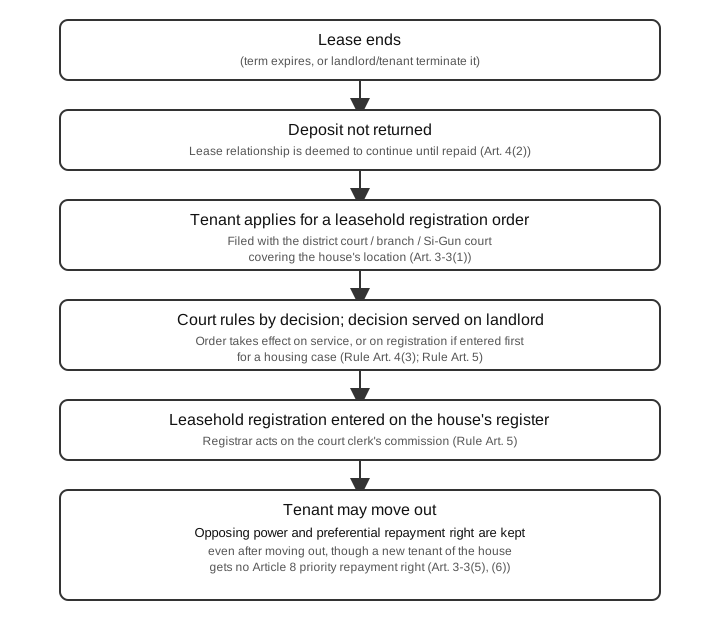
Based on Housing Lease Protection Act, Articles 3-3(1), (5), (6), and 4(2); Rules on Procedure for Lease Registration Orders, Articles 4(3) and 5.
Three common misunderstandings
“I lose my protection the moment I move out.” Not if the leasehold registration is already entered. Once it’s completed, the opposing power and preferential repayment right you already had are maintained even after you lose the possession-and-registration requirements that originally created them (Article 3-3(5)). Moving out is exactly what this procedure is meant to let you do safely — the risk is moving out before the registration is in place.
“I can file for this as soon as I’m worried my landlord won’t pay.” The application is only available after the lease has actually ended and the deposit hasn’t been refunded (Article 3-3(1)). Anticipated trouble during an ongoing lease isn’t a basis for this particular application.
“The order protects me from the moment I file it.” It doesn’t. The order takes effect when the decision is served on the landlord, or — for a housing case specifically — when the registration is entered first under the proviso to Rule Article 5 (Rule, Article 4(3)). There can be a gap between filing and the point the order takes effect, and a further gap before the leasehold registration is actually entered on the register. The protection that survives moving out attaches to the completed registration (Article 3-3(5)) — so moving out before the registration appears on the register, even after the decision has been served on the landlord, is not covered.