In short: a Korean housing lease can renew in one of two ways. If neither side gives notice in the window running from six months to two months before the term ends, the lease renews automatically on the same terms — this is “silent renewal” (Article 6). Separately, a tenant has a one-time right to actively request renewal in that same window, which the landlord can refuse only on one of nine specific grounds (Article 6-3). Either way, any rent or deposit increase on renewal is capped at 5% of the current amount, and cannot be requested again within a year (Article 7; Enforcement Decree, Article 8).
Silent renewal: what happens if nobody says anything
Article 6(1) sets the default rule for what happens when a lease term is about to end and neither party has acted: “If the lessor fails to notify the lessee of a refusal of the renewal, or to give notification to the lessee to the effect that he or she would not renew the contract without any change in the condition, six months to two months before the term of the lease expires, the lease shall be deemed to have been renewed under the same conditions as the former one at the time the term expires. The same shall apply to cases where the lessee has not notified by two months before the term of the lease expires” (Housing Lease Protection Act, Article 6(1)).
Two separate deadlines are packed into that sentence:
- The landlord’s window runs from six months to two months before the term ends. If the landlord does not, inside that window, either notify a refusal to renew or notify a change in terms, the lease renews.
- The tenant also has to act by two months before the term ends. If the tenant stays silent past that point too, the same automatic renewal applies.
If both sides say nothing, the lease “shall be deemed to have been renewed under the same conditions as the former one” once the term expires (Article 6(1)), and the renewed term is treated as two years (Article 6(2)).
Silent renewal does not apply to a tenant who has fallen behind on rent by an amount equal to two months’ rent, or who has otherwise seriously violated their obligations under the lease (Article 6(3)) — for that tenant, the landlord’s silence does not trigger an automatic renewal.
Ending a silently renewed lease
A lease that renewed this way is not locked in for the tenant. Article 6-2(1) lets the tenant “notify the lessor of the termination of the contract at any time, notwithstanding paragraph (2) of [Article 6]” — meaning the tenant is not bound by the two-year term the way the landlord is. The termination does not take effect immediately, though: it “shall take effect three months after the lessor receives such notice” (Article 6-2(2)).
The tenant’s one-time renewal request
Separately from silent renewal, a tenant can actively request that the lease be renewed. Article 6-3(1) states the rule: “Notwithstanding Article 6, where a lessee requests the renewal of a contract within the period prescribed in the former part of Article 6(1), a lessor shall not refuse the request without good reason” — that is, inside the same six-to-two-month window described above.
The landlord’s ability to refuse is limited to nine listed grounds (Article 6-3(1)1–9):
- The tenant has fallen behind on rent by an amount equal to two months’ rent;
- The tenant entered the lease by fraud or other improper means;
- The landlord and tenant mutually agreed, with the landlord providing substantial compensation;
- The tenant sublet all or part of the house without the landlord’s consent;
- The tenant intentionally or through gross negligence damaged all or part of the house;
- All or part of the house has been destroyed, so the purpose of the lease can no longer be fulfilled;
- The landlord needs to recover possession to demolish or reconstruct all or most of the house, and one of three specific situations applies: the landlord disclosed a concrete demolition or reconstruction plan (including timing) at the time the lease was signed and is following that plan; the building is old, damaged, or partially destroyed and there is a safety-accident risk; or the demolition or reconstruction is required under other statutes;
- The landlord, or the landlord’s lineal ascendant or descendant, intends to actually live in the house;
- The tenant has otherwise seriously violated their obligations, or there is another significant reason making it difficult to continue the lease.
If none of these apply, the landlord cannot refuse the request. This right can be exercised only once, and a renewal granted this way also runs for two years (Article 6-3(2)). A renewal under this article is deemed entered into under the same conditions as the previous lease, except that rent and deposit may be adjusted within the Article 7 limit described below (Article 6-3(3)). Ending a lease renewed this way follows the same rule as silent renewal — the tenant can terminate at any time, effective three months after the landlord receives notice (Article 6-3(4), applying Article 6-2).
If the landlord refuses to renew and then re-lets the house anyway
Ground 8 above — the landlord wanting to live in the house — comes with a specific consequence if it turns out not to be true. If the landlord refused the renewal request on that ground, and then, without good reason, leases the house to a third party before the date the renewed term would have expired had the request been granted, the landlord must compensate the tenant for the resulting loss (Article 6-3(5)).
Unless the parties agreed on a compensation amount in advance at the time of the refusal, the amount owed is the largest of three figures (Article 6-3(6)):
- Three months’ worth of the monthly rent at the time of the refusal — with any deposit converted into a monthly-rent equivalent using the lower of the conversion rates in Article 7-2;
- Two years’ worth of the difference between the converted monthly rent the landlord actually obtained from the new tenant and the converted monthly rent the refused tenant was paying;
- The tenant’s actual proven loss from the refusal.
The 5% cap on any rent or deposit increase
Whichever way a lease renews, an increase to the agreed rent or deposit is capped. Article 7(1) allows either party to request an adjustment “if the stipulated rent or deposit becomes unreasonable due to increase or decrease of taxes, public dues, and other charges on the leased house, or a change in economic circumstances,” but adds a timing limit: “no request for an increase shall be made within one year after a lease contract is concluded or the rent or deposit agreed upon is increased” (Article 7(1)).
The size of any increase is separately capped by Article 7(2): “An increase requested under paragraph (1) shall not exceed 1/20 of the agreed rent or deposit” — in other words, 5%. A city or province may set a lower ceiling by local ordinance for its own area, but not a higher one (Article 7(2)). The Enforcement Decree restates the same two rules for the rent-increase context specifically: the increase cannot exceed 1/20 of the agreed amount, and cannot be requested within one year of the contract or the last increase (Enforcement Decree, Article 8(1), (2)).
This 5% ceiling is what limits a landlord on a renewal under Article 6-3, since that article only allows rent and deposit to move “within the range under Article 7” (Article 6-3(3)). Article 7 itself is framed as a limit on a request for an increase; this article does not cover whether the cap reaches a new contract that both parties agree to after the lease ends.
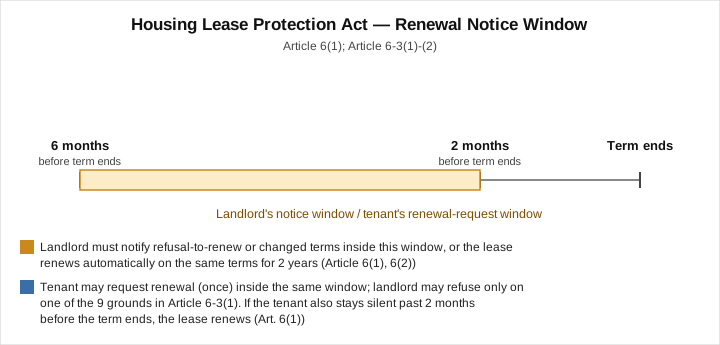 Based on Housing Lease Protection Act, Article 6(1) and Article 6-3(1)-(2): both the landlord’s notice window and the tenant’s renewal-request window run from six months to two months before the lease term ends.
How the timeline actually plays out
Because both silent renewal and the renewal request key off the same window, it helps to walk through the sequence:
- Six months before the term ends, the notice window opens. From this point, either the landlord can send a notice of refusal (or of changed terms), or the tenant can send a request for renewal.
- Any time up to two months before the term ends, if the landlord has said nothing and the tenant wants an active renewal (rather than waiting for silent renewal), the tenant can exercise the Article 6-3 request — a step the tenant would typically take if there’s a specific reason to want the renewal formally documented, or if the tenant wants certainty before the window closes.
- At two months before the term ends, the tenant’s own deadline arrives. If the tenant has not said anything either, silent renewal under Article 6(1) applies once the term expires — same conditions, same effect as a renewal, for a further two years (Article 6(2)).
- Once a renewal has occurred — silent or requested — either party may seek an adjustment to rent or deposit under Article 7, but only within the 5% cap and not within a year of the last change (Article 7(1), (2)).
Three common misconceptions
“If my landlord doesn’t renew my lease on paper, I have to move out.” Not if the landlord missed the notice window. Article 6(1) makes renewal automatic — on the same terms, for two years — when the term expires, if the landlord gave no refusal or change-of-terms notice inside the six-to-two-month window (and the tenant also gave no notice by two months before the term ends). No new paperwork is required for this renewal to take effect.
“I can ask for renewal, but my landlord can refuse for any reason.” The landlord’s refusal has to fit one of the nine specific grounds in Article 6-3(1) — rent arrears, fraud, mutual agreement with compensation, unauthorized subletting, damage to the house, destruction of the house, a qualifying demolition or reconstruction plan, the landlord or a close relative intending to live there, or another serious breach. A reason outside that list does not defeat the request.
“Once I’ve renewed, my landlord can raise the rent to match the current market rate.” Not through a request for an increase. On a renewal under Article 6-3, rent and deposit can move only within Article 7 (Article 6-3(3)), and an increase request cannot exceed 5% of the currently agreed amount or be made within a year of the contract or the last increase (Article 7(1), (2); Enforcement Decree, Article 8).
There is no translation lag to flag for this article: the sections quoted above are current as of the Korean text in force (promulgated October 1, 2025, effective January 2, 2026), and the Act’s English translation matches. For what happens if your landlord fails to return your deposit once the lease genuinely ends, see Jeonse and wolse deposits: move-in registration, 확정일자, and how your deposit is protected.