In short: An E-7 holder and an E-9 holder change their workplace under two different laws, with two different procedures, and only one of them faces a numeric limit on how many times they can do it. An E-7 holder who also meets requirements publicly notified by the Minister of Justice reports the change within 15 days instead of getting prior permission (Immigration Act, Article 21(1) proviso; Enforcement Decree, Article 26-2(1)). An E-9 holder — employed under the Employment Permit System — first applies to a public employment security office for a transfer to another business or place of business on one of three grounds set out in the Act on the Employment of Foreign Workers, and then still needs workplace-change permission under the Immigration Act within a set window (Act on the Employment of Foreign Workers, Article 25(1), (3)). This article works through both tracks article by article, using only the text of the Immigration Act, its Enforcement Decree, the Act on the Employment of Foreign Workers, and its Enforcement Decree.
E-7: report, not permission
The Immigration Act’s default rule for every foreign national staying in Korea is permission first: if you intend to change or add a workplace within the scope of your status of stay, you must obtain the Minister of Justice’s prior permission, as prescribed by Presidential Decree (Immigration Act, Article 21(1), main clause). Employing a foreign national who lacks that permission, or arranging such employment, is prohibited; the exception covers only arranging employment under another Act (Immigration Act, Article 21(2)).
E-7 is carved out of that default. The Article 21(1) proviso replaces prior permission with a post-change report for “a person prescribed by Presidential Decree” who has expert knowledge, skill, or ability — and the Enforcement Decree of the Immigration Act defines that group by reference to Appendix 1-2: everyone from category 14, Professor (E-1), through category 20, Foreign National of Special Ability (E-7), who also satisfies requirements the Minister of Justice separately publicly notifies (Enforcement Decree of the Immigration Act, Article 26-2(1)). Those publicly notified requirements are set by the Ministry of Justice and are not covered in this article. What the statute itself sets is the deadline: the report must be filed within 15 days of the change or addition of workplace (Immigration Act, Article 21(1) proviso).
The report procedure itself runs through the Enforcement Decree. You submit a report on the change or addition of workplace, together with documents prescribed by Ministry of Justice rule, to the head of an Immigration Office, the head of an office, or the head of a branch office (Enforcement Decree of the Immigration Act, Article 26-2(2)). That office forwards the report and its attachments to the Minister of Justice without delay (Enforcement Decree of the Immigration Act, Article 26-2(3)). If the Minister of Justice accepts the report, the office places a report stamp on your passport and enters the changed or added workplace and the period of stay or effective period, or affixes a report sticker instead (Enforcement Decree of the Immigration Act, Article 26-2(4)). If the report is not accepted, the office notifies you of that in a form the Ministry of Justice prescribes (Enforcement Decree of the Immigration Act, Article 26-2(5)).
For comparison, the ordinary permission track — for status categories that are not on the Appendix 1-2 list of expert categories — works the same way in outline but requires the Minister of Justice’s advance approval rather than a post-change report: an application with prescribed documents goes to the same immigration offices, is forwarded to the Minister of Justice with the office’s opinion, and results in either a permission stamp/sticker with the changed or added workplace and period entered, or a notice of refusal in the prescribed form (Enforcement Decree of the Immigration Act, Article 26(1)-(5)). Article 21(1) itself does not set a limit on how many times a status holder covered by the proviso may report a change, and none of the provisions reviewed for this article adds one for E-7.
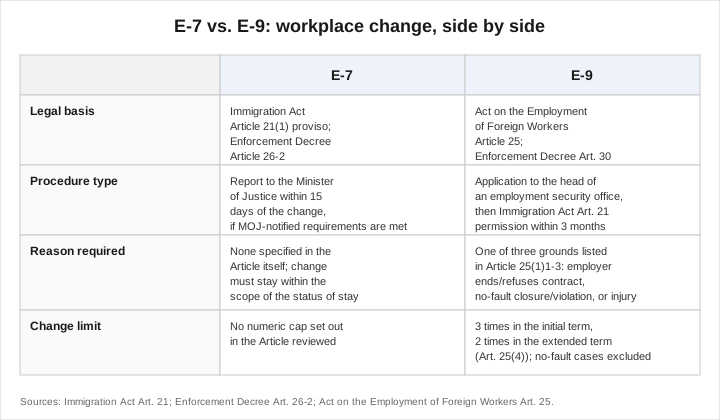
Legal basis for the chart: Immigration Act Article 21; Enforcement Decree of the Immigration Act Article 26-2; Act on the Employment of Foreign Workers Article 25.
E-9: an application to change sector or workplace, on one of three grounds
An E-9 worker is employed under the Employment Permit System that the Act on the Employment of Foreign Workers governs, and that Act — not the Immigration Act’s Article 21 permission/report split alone — sets the substantive conditions for changing employer. A foreign worker under this Act (other than a foreign worker under Article 12(1), which this article does not cover) may apply to the head of an employment security office for a transfer to another business or place of business, as prescribed by Ministry of Employment and Labor rule, but only where one of three grounds has occurred (Act on the Employment of Foreign Workers, Article 25(1)):
- The employer intends, on a justifiable ground, to terminate the labor contract during the contract period, or to refuse to renew it after it expires (Article 25(1)1).
- The Minister of Employment and Labor publicly notifies that the worker cannot reasonably be expected to keep working at that business or place of business for a reason not attributable to the worker — the Act lists temporary shutdown, closure of business, revocation of the employer’s employment permit under Article 19(1), a restriction on the employer’s ability to hire under Article 20(1), providing a dormitory in violation of Article 22-2, or the employer’s violation of working conditions or unfair treatment of the worker (Article 25(1)2).
- Any other cause or event prescribed by Presidential Decree — which the Enforcement Decree defines as an injury or similar condition that makes the worker unfit to keep working at that particular business or place of business, while still being fit to work somewhere else (Act on the Employment of Foreign Workers, Article 25(1)3; Enforcement Decree of the Act on the Employment of Foreign Workers, Article 30(1)).
Once a worker has applied for a transfer under Article 25(1), an employer who wants to hire that worker for re-employment follows the same recruitment procedure the Act sets for hiring any Employment Permit System worker in the first place (Act on the Employment of Foreign Workers, Article 25(2), applying Articles 6, 8, and 9 by reference). The application to the employment security office is only the labor side of the process, though. Because a workplace change also changes where the worker is authorized to stay, the worker separately needs workplace-change permission under Article 21 of the Immigration Act — and there is a clock on that: the worker must leave the Republic of Korea if permission under Immigration Act Article 21 has not been obtained within 3 months of applying for the transfer, or if the worker does not apply for a transfer within 1 month after the labor contract with the employer ends. If an on-duty injury, illness, pregnancy, or childbirth prevents the worker from obtaining that permission or from applying for the transfer, the relevant period is instead counted from the day that cause ceases to exist (Act on the Employment of Foreign Workers, Article 25(3)).
Where to go. The transfer application is made to the head of an employment security office, meaning a public employment center (Act on the Employment of Foreign Workers, Article 25(1)). The Employment Permit System site (eps.go.kr), run for these workers, describes the same timing in its own terms: the transfer application must be made within 1 month after the employment contract ends, and the job search after applying is valid for 3 months. The legal consequence is the one in Article 25(3) above: without workplace-change permission within 3 months of applying, the worker must leave Korea, subject to the later start date described there for on-duty injury, illness, pregnancy, or childbirth. For questions about employment and labor rules, the Ministry of Employment and Labor’s call center is 1350 (weekdays 9:00 a.m. to 6:00 p.m.; call charges apply).
Unlike E-7, E-9 workplace changes carry a numeric cap. In principle, a worker may not change business or place of business more than 3 times during the initial employment period set under Article 18 of the Act, nor more than 2 times during any period extended under Article 18-2(1) — but a change made on the no-fault ground in Article 25(1)2 (such as the employer’s temporary shutdown, closure, permit revocation, hiring restriction, dormitory violation, or violation of/unfair treatment regarding working conditions) does not count toward either cap (Act on the Employment of Foreign Workers, Article 25(4)). Paragraph (2) of Article 30 of the Enforcement Decree is marked “Deleted” (May 14, 2012); paragraph (3) requires the employment security office to notify the immigration office of workers due to leave under Article 25(3) (Enforcement Decree of the Act on the Employment of Foreign Workers, Article 30(2), (3)).
Scheduled change: Act No. 21786, promulgated June 9, 2026, amends Article 25(1)2 and Article 22-2 of the Act on the Employment of Foreign Workers. Under the Addenda of Act No. 21786, the Act takes effect six months after promulgation, but its proviso sets June 10, 2027 (one year after promulgation) for the amendments to Article 22-2 and Article 25 only. A new Article 22-3 on support for local governments, added by the same Act, is not covered by that proviso. The substantive change to Article 25(1)2 is a wording swap: the no-fault ground currently described as an employer “providing a dormitory in violation of Article 22-2” becomes providing “residential facilities” in violation of Article 22-2. Article 22-2 itself is also rewritten from dormitories to residential facilities, with new standards the employer must meet, which this article does not cover. The three-grounds structure, the 3-times/2-times change limit in Article 25(4), and the other paragraphs of Article 25 are not part of this amendment.
Three common misunderstandings
“E-7 workers need the same advance permission as everyone else.” Not under the text reviewed here. E-7 falls within the Appendix 1-2 range the Enforcement Decree of the Immigration Act singles out for the report track, so the change is reported within 15 days after it happens, rather than approved beforehand — provided the worker also meets requirements the Minister of Justice separately publicly notifies (Immigration Act, Article 21(1) proviso; Enforcement Decree of the Immigration Act, Article 26-2(1)).
“E-9 workers can change employer for any reason.” Not under the text reviewed here. An E-9 worker’s application to the employment security office is only valid if it fits one of the three grounds in Article 25(1) — an employer-initiated contract end, a no-fault reason the Minister of Employment and Labor has publicly notified, or an injury-type cause set by Presidential Decree (Act on the Employment of Foreign Workers, Article 25(1)1-3). There is no general “I want to change jobs” ground in the provision.
“The 3-times/2-times limit applies to every workplace change an E-9 worker makes.” Not quite — a change made on the no-fault ground in Article 25(1)2 (such as temporary shutdown, closure, permit revocation, a dormitory violation, or the employer’s violation of working conditions or unfair treatment, as publicly notified by the Minister of Employment and Labor) is expressly excluded from the count (Act on the Employment of Foreign Workers, Article 25(4)). Only changes made on the other grounds count toward the 3-times/2-times cap.
A note on translations: the official English translation of the Immigration Act reflects the amendment promulgated July 22, 2025, while the Korean text now in force was promulgated August 4, 2026 (effective October 2, 2026), an amendment that leaves Article 21 cited here unchanged; the Act on the Employment of Foreign Workers’ English and Korean texts both reflect the promulgation of October 1, 2025 (also its effective date). Neither official English translation yet reflects the June 9, 2026 amendment described in the Scheduled change section above, since that amendment is not yet in force. Once your workplace changes, so does the employer who owes your social insurance contributions — see The four social insurances for foreign employees in Korea for how National Pension, National Health Insurance, Employment Insurance, and Industrial Accident Insurance follow you across that change.